
It is a typical question when you hear it or someone asks you. This is the compilation of 15 Cars that changed the automobile industry. How they changed the Industry?
These vehicles were the first of their kind and they influenced the design and performance aspects of the entire Automobile Industry. These vehicles changed the look and feel of the motoring world and not only carved a place in history, they’ll continue to influence the auto world for years to come. This compilation consists of vehicles first to use power steering, airbags, advanced fuel injection, AWD, V8 or V12 etc.
1) Ford Model T:
Launched Year - 1908
The Model
T, also known as the “Tin Lizzie,” changed the way Americans live, work and travel. Henry Ford’s revolutionary advancements in assembly-line
automobile manufacturing made the Model T the first car to be affordable for a
majority of Americans. For the first time car ownership became a reality for
average American workers, not just the wealthy. So they
were sold more than 15 million. Conceived by Henry Ford as practical, affordable transportation for the common
man, it quickly became prized for its low cost, durability, versatility, and
ease of maintenance. Assembly-line production allowed the
price of the touring car version to be lowered from $850 in 1908 to less than
$300 in 1925.
The Model
T was offered in several body styles, including a five-seat touring car, a
two-seat runabout, and a seven-seat town car. All bodies were mounted on a uniform 100-inch-wheelbase chassis.The engine generated
20 horsepower and propelled the car to modest top speeds of 40–45 miles per
hour (65–70 km/h). The transmission, consisting of two forward gears and
one reverse, was of the planetary type, controlled by foot
pedals rather than the more common hand lever used in sliding-gear
transmissions.

2) Volkswagen Beetle:
Launched Year - 1938
The Volkswagen Type 1, more commonly known as the
Beetle, Fusca, Coccinelle, Vocho, Bug, Volky or Käfer (German), is a compact
car, produced by Volkswagen from 1938 until 2003. In 1933 Adolf Hitler met with Ferdinand Porsche to
discuss the development of a "Volks-Wagen" ("People Car"),
a basic vehicle that should be capable of transporting two adults and three
children at a speed of 100 km/h (62 mph). The car was designed
to be as simple as possible mechanically, so that there was less to go wrong;
the aircooled 985 cc 25 hp (19 kW) motors proved especially effective in
actions of the German Afrika Korps in North Africa's desert heat. This was due
to the built-in fan-cooling and the superior performance of the flat-four
engine configuration. The innovative suspension design used compact torsion
beams instead of coil or leaf springs.
The original Beetle had
the longest production run of any vehicle ever. It was a top-seller in the U.S.
for years during the 1950s and set the standard for small cars like the
Chevrolet Corvair and Ford Pinto. In the
international poll for the award of the world's most influential car of the
twentieth century the Beetle came fourth after the Ford Model T, the Mini and
the Citroën DS. On the 15th May 1981 the 20 Millionth Beetle was
produced in Mexico. Today Mexico is the only country in the world
which still manufactures the Beetle.

3) FERRARI 125 S:
Launched Year - 1947
This was the very first car to wear the Ferrari badge. The
V12 engine was designed by Gioachino Colombo. Sport and competition versions of the 125 S were built with
different bodywork although the chassis and running gear of the cars remained
basically identical. The 125
S’s debut on the Piacenza circuit was, in the words of Enzo Ferrari himself, “a
promising failure.” In fact, Franco Cortese had to pull out because of a
problem with the fuel pump while leading the race. However, over the following
four months, the 125 S was back on the track 13 times, winning six of its races.
The 125 S used a steel tube-frame chassis and had a double wishbone suspension with transverse leaf
springs in front with alive axle in the rear. Hydraulic power drum
brakes were specified front and rear. The 125 S was powered by Gioacchino
Colombo's 1.5 L (1497 cc/91 in³) 60° V12 with a bore/stroke of 55 x 52.5 mm . This engine produced 118 bhp
(87 kW) at 6,800 rpm with a compression
ratio of 9.5:1. It was a single
overhead camshaft design with 2 valves per cylinder and three
double-choke Weber 30DCF carburettors. They used a five-speed gearbox as it matched the high revving V12 better than
that of a traditional four-speed gearbox.

4)Jaguar XK 120
Launched Year - 1948
With its French curves, 120 mph
performance and a price tag of £988, the XK120 was Jaguar's most important
roadster. In 1948 it set a new standard of post-war performance which
progressed into a comprehensive motor sports campaign and won the 24 Hours of Le
Mans five times in seven years. The "120" in the name referred
to the car's documented 120 mph (193 km/h) top speed which made it the world's
fastest production car at the time of its launch. The roadster caused such a
sensation that Jaguar was forced to put the car into production before any
tooling for the body panels had been manufactured.
This vehicle has a 2 door
roadster type body styled by William Lyons with a front positioned engine
driving through the rear wheels. The Jaguar XK 120 SE Roadster's engine is
a naturally aspirated petrol, 3.4 litre, double overhead camshaft 6 cylinder
with 2 valves per cylinder. This unit develops 180 bhp (183 PS/134 kW) of power
at 5300 rpm, and maximum torque of 275 N·m (203 lb·ft/28 kgm) at 4000
rpm. Its claimed kerb weight is 1295 kg. XK engine was the
world's first affordable and mass-produced twin-cam unit.

5) MERCEDES 300SL GULLWING
Launched Year - 1954-57
Eternal youth is a miracle bestowed on only a small number
of cars, and the Mercedes-Benz 300 SL coupe is one of this elite group. The
Stuttgart-based brand unveiled its new sports car in February 1954. With
its flat, graceful body, the 300 SL had lost nothing of its freshness even as
the millennium drew to a close and was voted "Sports car of the
Century" in 1999. "Gullwing" doors provided that essential touch
of inspiration, opening up towards the sky to reveal a tightly sculptured
interior. It was also the first ever petrol-powered car to use fuel
injection.
The six-cylinder engine featured a number of modifications,
one of which saw the carburetor replaced by a direction injection system - a
technical advance which was years ahead of its time. This new technology
boosted output to 158 kW (215 hp) and the car's maximum speed up as far as 260
km/h, depending on the rear axle ratio. Customers could order their SL with a
choice of five different ratios. The standard 1:3.64 variant was set up
primarily to deliver rapid acceleration and capable of 235 km/h. The 1:3.89 and
1:4.11 ratios were good for even faster acceleration, whilst the 1:3.42 option
offered a higher top speed. This figure rose still further - to 260 km/h - when
the ratio was set at 1:3.25. The 300 SL hit 100 km/h in just 10 seconds,
with car testers at the time measuring fuel consumption at an average of 15
liters per 100 km. A 100-liter fuel tank was positioned at the rear of the car
and could be enlarged to 130 liters at an extra charge. The 300 SL has
been counted among the world's most sought-after and highly rated cars for 50
years now, and its status as one of the most revered classic automobiles on the
market is set to remain intact for quite some time to come.

6) LOTUS
ELITE:
Launched Year - 1957
The Elite was not the sort of
car to be handed down from father to son with pride and a great deal of
reluctance. Rather, it was the sort of car to be passed on with an incredulous
grin and a slight shrug of the shoulders. It was a car so technically advanced
for its day that the whole motoring world sat up and took notice of its
launch.The Elite bristled with advanced features. For one thing, it
distinguished itself by being the first car in the world to utilize a
fiberglass monocoque structure. Monocoques were old hat by 1957, and so were
fiberglass bodies, but the two features had never before been married together.
In addition, the Elite sported a smooth, aerodynamic shape at a time when
sports cars still had knobby looks.
The first Elite entered
production in 1957 and it was powered by a small 1.2L, four-cylinder in line
carburetor engine available with two outputs: 72 HP and 77 lb. ft. of torque
and 84 HP and 75 lb. ft. of torque. The two-door coupe sports car had
rear-wheel drive and a four-speed manual gearbox. It's worth noting that the
Elite had a very low 0.29 drag coefficient. The model exited production in
1963, a total of around 1030 being manufactured over the 6-year existence.

7) BUGATTI TYPE 57 ATLANTIC:
Launched Year - 1936
Ever
wanted to know what the world’s most expensive car is? Bugatti Veyron, maybe a
tailor-made Ferrari of some sort? Nope, it’s probably more likely to be this
1937 Bugatti Type 57SC Atlantic. It sold for US$30-40 million at auction. Perhaps the most beautiful and exotic (and certainly the
most expensive) automobile in history is the Bugatti Type 57SC Atlantic.
With
graceful styling, a powerful engine, and lightweight construction, the vehicles
were as impressive with the performance as they were with their design. The
design was courtesy of Ettore's son, Jean Bugatti. It was influenced by
aircraft styling and given an avant-grade tear-drop shape. In the front was a
raked windscreen, kidney-shaped doors with matching side windows, and the
memorable riveted fins in the back. The riveted fins in the back were not
just a design expression, they were a necessary part of the construction. The
body was built from Electron, an alloy of aluminum and magnesium from IG Farben
of Germany. It was lightweight and strong, but it was also very flammable.
Thus, it was not able to be welded. The solution proposed by Jean was to use
rivets.

8) Trabant:
Launched Year - 1958
The Trabant was a product of East Germany’s centrally
planned economy. Introduced in 1958, the Trabant was built by VEB
Sachsenring, a state-owned automobile manufacturer whose factory was located in
Zwickau, East Germany. It was essentially East Germany’s answer to the
Volkswagen Beetle. The overall design of the Trabant was
unique. It had a number of features that were reasonably advanced at the
time of its 1958 introduction, including front-wheel drive, unitary
construction, and four-wheel independent suspension. But it also
possessed a number of patently outdated features, particularly a small and
under powered 2-cylinder 2-stroke engine, which was notorious for being noisy,
smoky, and not particularly fuel efficient. Most prominently and peculiarly,
the Trabant featured a body shell fabricated from Duroplast, a plastic material
that was usually manufactured from recycled cotton fibers and recycled phenol
resins. Despite all this, it
had a 30-year production run with more than 3 million made.

9) CADILLAC:
Launched Year - 1959
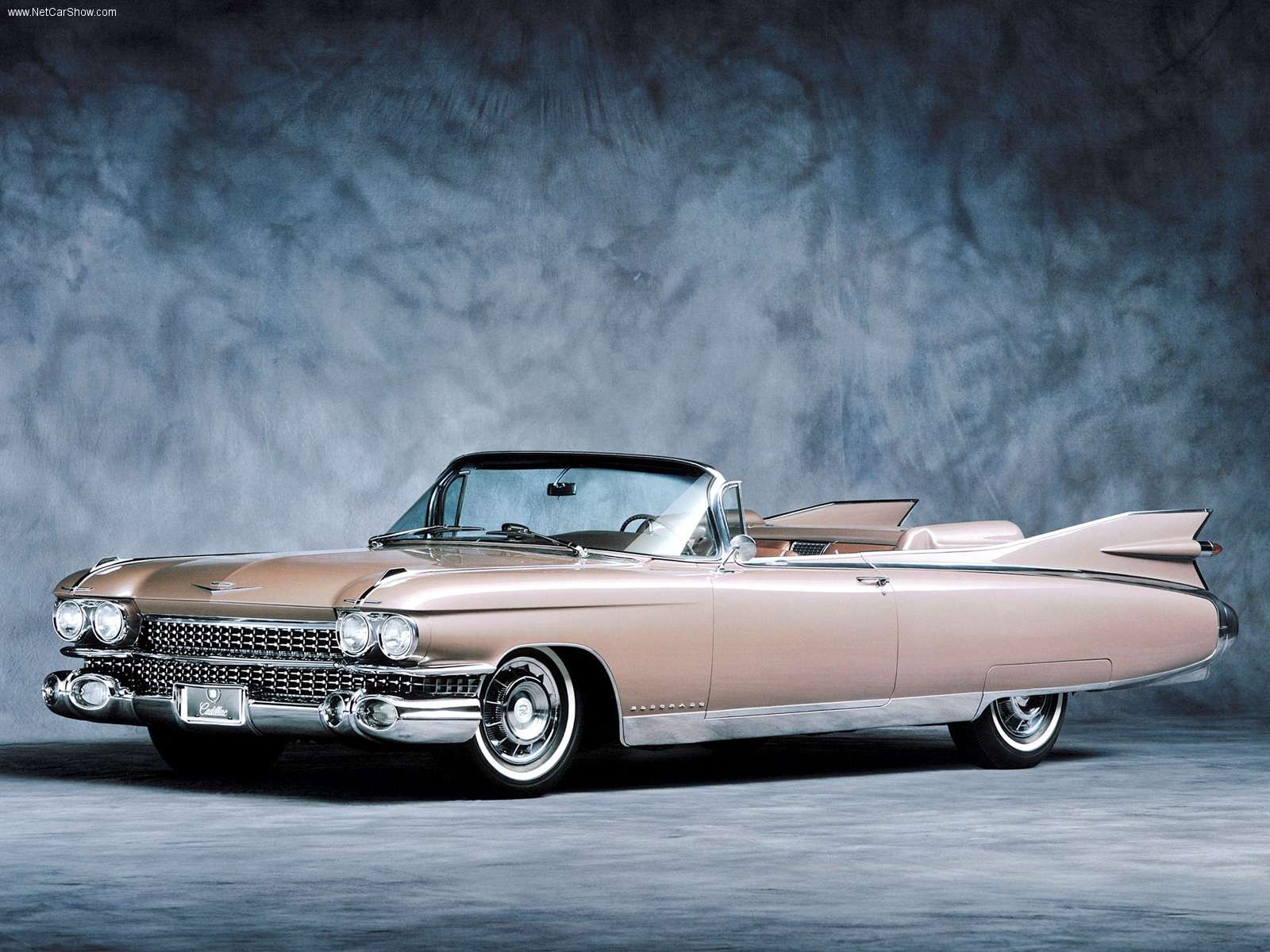
No car evoked the same sense of national identity as much as the 1959
Cadillac. The 1959 Cadillac is remembered
for its huge sharp tail fins with dual bullet tail lights, two distinctive
rooflines and roof pillar configurations, new jewel-like grille patterns and
matching deck lid beauty panels. New mechanical items were a
"scientifically engineered" drainage system and new shock absorbers. All
Eldorados were characterized by a three-deck, jeweled, rear grille insert, but
other trim and equipment features varied. The Seville and Biarritz models had
the Eldorado name spelled out behind the front wheel opening and featured
broad, full-length body sill highlights that curved over the rear fender
profile and back along the upper beltline region.
Engine output was an even
345 hp (257 kW) from the 390 cu in (6.4 L) engine.
Standard equipment included power brakes, power steering, automatic transmission,
back-up lamps, windshield wipers, two-speed wipers, wheel discs, outside
rear view mirror, vanity mirror, oil filter, power windows, six way power seats,
heater, fog lamps, remote control deck lid, radio and antenna with rear
speaker, power vent windows, air suspension, electric door locks and license
frames. The Eldorado Brougham also came with Air conditioning,
automatic headlight dimmer, acruise control standard over the Seville and
Biarritz trim lines.
10) JAGUAR
E TYPE:
Launched Year - 1961
To
the British motor industry, the name of Jaguar spells success.The Jaguar
E-Type (a.k.a. Jaguar
XK-E) is a British sports car, which was manufactured by Jaguar
Cars Ltd between
1961 and 1975. Its combination of good looks, high performance and competitive
pricing established the marque as an icon of 1960s motoring. More than 70,000
E-Types were sold.
On its release Enzo Ferrari called it "The most beautiful car ever made".
In March 2008, the Jaguar E-Type ranked first in a The
Daily Telegraph online list of the world's "100
most beautiful cars" of all time.
In 2004, Sports Car International magazine
placed the E-Type at number one on their list of Top
Sports Cars of the 1960s.
This
automobile has a 2 door coupé type body with a front positioned engine
supplying power to the rear wheels. The Jaguar E-Type 3.8's engine is a
naturally aspirated petrol, 3.8 litre, double overhead camshaft 6 cylinder with
2 valves per cylinder. This powerplant has an output of 265 bhp (269 PS/198 kW)
of power at 5500 rpm, and maximum torque of 353 N·m (260 lb·ft/36 kgm) at 4000
rpm. A 4 speed manual 'box delivers the power to the driven wheels.
With a stated kerb weight of 1234 kg, the Jaguar E-Type 3.8 manages to cover
the 0-60 mph sprint in 6.9 seconds and the standing quarter mile in 14.7
seconds. Maximum stated speed is 241 km/h (150 mph).

11) PORSCHE 911 :
Launched Year - 1968
It showed the world German
car manufacturing wasn’t a two horse race between Volkswagen and Mercedes. It
has one of the longest production runs of any car sold in the UK and US
markets. It uses the same air- cooled engine technology developed by Ferdinand Porsche in the
Volkswagen Beetle until 1998.
The Porsche 911 is a 2 door coupé style motor vehicle with a rear located engine supplying power to the rear wheels. Powering the Porsche 911S is a single overhead camshaft, 2 litre naturally aspirated dry-sumped 6 cylinder powerplant, with 2 valves per cylinder that provides power and torque figures of 170 bhp (172 PS/127 kW) at 6800 rpm and 183 N·m (135 lb·ft/18.7 kgm) at 5500 rpm respectively. It features dry sump-type lubrication. A 5 speed manual gearbox supplies the power to the driven wheels. The quoted kerb weight is 1080 kg. It is said to be able to attain a maximum speed of 225 km/h (140 mph).

12) Ford Mustang:
Launched Year - 1964
The first-generation Ford Mustang was manufactured by the Ford Motor Company from April 1964 until 1973. The introduction of the Mustang created a new class of automobile known as the pony car. The Mustang’s styling, with its long hood and short deck, proved wildly popular and inspired a host of imitators. This is the car that
started America’s love affair with muscle and punch. It was the first of its
kind and a wildly popular hit from the start.
The Ford Mustang as the first -- and
so far the only -- car to receive the Tiffany Award for Excellence in American
Design. They all are powered by the 260 cubic-inch V8 engine and equipped with
power steering, back-up lights and an automatic transmission. Other special
features include the blue racing stripe and 'Official Pace Car' decals along
the sides.

13) Jeep Cherokee:
Launched Year - 1974
The SJ series Jeep Cherokee was a full-size SUV
produced from 1974 through 1983 by the Jeep division of the American Motors
Corporation. It was similar to the Wagoneer. Other than the base model, the
trim levels of the Cherokee included the S (Sport), Chief, Golden Eagle,
Limited, Classic, Sport, Pioneer, and Laredo. It was designed by Brooks Stevens.

14) LAMBORGHINI MIURA:
Launched Year - 1966
The Lamborghini Miura is a sports car that was produced by Italian automaker Lamborghini between 1966 and 1973. The car is widely considered to have instigated the trend of high performance, two-seater, mid-engined sports cars. At launch, it was the fastest production road car available.
The Miura was originally conceived by Lamborghini's engineering team, who designed the car in their spare time against the wishes of company founder Ferruccio Lamborghini. He preferred powerful yet sedate grand touring cars, rather than the racecar-derived machines produced by local rival Ferrari.
At its debut the Miura was the fastest production car in the world: With a top speed of 280 kph and an acceleration from 0-100 kph in 6.7 seconds the Lamborghini Miura set new standards in the sports car segment. The original Miura was produced between 1966 and 1969. Between 1966 and 1969 475 units of the 350 HP Miura were produced. But the success story did not end there: The Miura was first developed further into the Miura S with 370 HP and later into the Miura SV, which had wider mud guards and a greatly revamped 385 HP engine with separate lubricating systems for engine and gearbox.

15) Toyota Prius:
Launched Year - 2000
The Toyota Prius is a full hybrid electric mid-size hatchback, formerly a compact sedan developed and manufactured by Toyota. The United States Environmental Protection Agency and California Air Resources Board (CARB) rate the Prius as among the cleanest vehicles sold in the United States based on smog-forming emissions.
The Prius is a passenger car from Toyota, with front wheel drive, a front located engine and a 5 door hatchback body style. The Toyota Prius is one of the NHW11 range of cars from Toyota. The 4 cylinder, double overhead camshaft naturally aspirated powerplant has 4 valves per cylinder and a capacity of 1.5 litres. In this application it musters power and torque figures of 71 bhp (72 PS/53 kW) at 4500 rpm and 115 Nm (85 lbft/11.7 kgm) at 4200 rpm respectively. A continuously variable transmission transfers the power to the driven wheels.
Claimed weight at the kerb is 1250 kg. It is said to be able to attain a maxiumum speed of 160 km/h.


7) BUGATTI TYPE 57 ATLANTIC:
Launched Year - 1936
Ever
wanted to know what the world’s most expensive car is? Bugatti Veyron, maybe a
tailor-made Ferrari of some sort? Nope, it’s probably more likely to be this
1937 Bugatti Type 57SC Atlantic. It sold for US$30-40 million at auction. Perhaps the most beautiful and exotic (and certainly the
most expensive) automobile in history is the Bugatti Type 57SC Atlantic.
With
graceful styling, a powerful engine, and lightweight construction, the vehicles
were as impressive with the performance as they were with their design. The
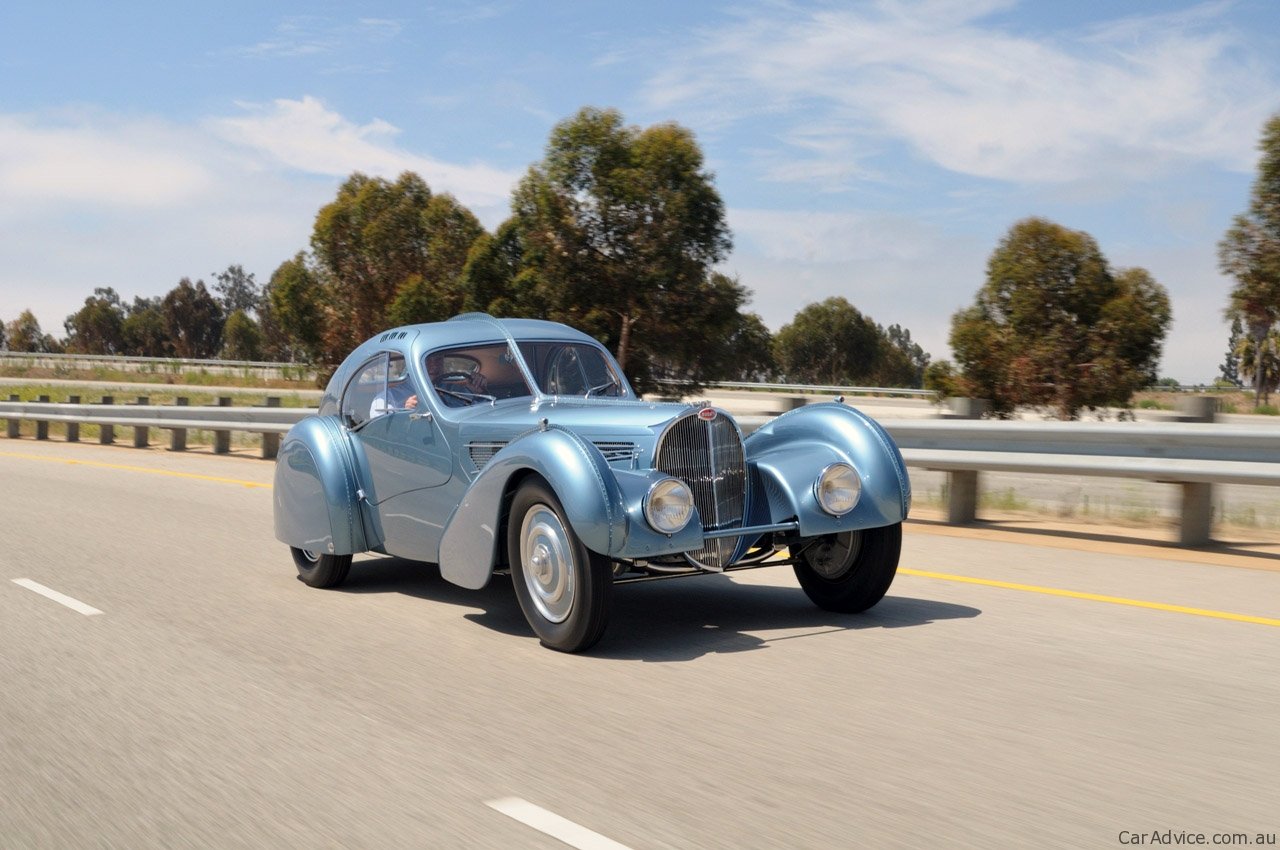
design was courtesy of Ettore's son, Jean Bugatti. It was influenced by
aircraft styling and given an avant-grade tear-drop shape. In the front was a
raked windscreen, kidney-shaped doors with matching side windows, and the
memorable riveted fins in the back. The riveted fins in the back were not
just a design expression, they were a necessary part of the construction. The
body was built from Electron, an alloy of aluminum and magnesium from IG Farben
of Germany. It was lightweight and strong, but it was also very flammable.
Thus, it was not able to be welded. The solution proposed by Jean was to use
rivets.
8) Trabant:
Launched Year - 1958
The Trabant was a product of East Germany’s centrally
planned economy. Introduced in 1958, the Trabant was built by VEB
Sachsenring, a state-owned automobile manufacturer whose factory was located in
Zwickau, East Germany. It was essentially East Germany’s answer to the
Volkswagen Beetle. The overall design of the Trabant was
unique. It had a number of features that were reasonably advanced at the
time of its 1958 introduction, including front-wheel drive, unitary
construction, and four-wheel independent suspension. But it also
possessed a number of patently outdated features, particularly a small and
under powered 2-cylinder 2-stroke engine, which was notorious for being noisy,
smoky, and not particularly fuel efficient. Most prominently and peculiarly,
the Trabant featured a body shell fabricated from Duroplast, a plastic material
that was usually manufactured from recycled cotton fibers and recycled phenol
resins. Despite all this, it
had a 30-year production run with more than 3 million made.

9) CADILLAC:
Launched Year - 1959
No car evoked the same sense of national identity as much as the 1959
Cadillac. The 1959 Cadillac is remembered
for its huge sharp tail fins with dual bullet tail lights, two distinctive
rooflines and roof pillar configurations, new jewel-like grille patterns and
matching deck lid beauty panels. New mechanical items were a
"scientifically engineered" drainage system and new shock absorbers. All
Eldorados were characterized by a three-deck, jeweled, rear grille insert, but
other trim and equipment features varied. The Seville and Biarritz models had
the Eldorado name spelled out behind the front wheel opening and featured
broad, full-length body sill highlights that curved over the rear fender
profile and back along the upper beltline region.
Engine output was an even
345 hp (257 kW) from the 390 cu in (6.4 L) engine.
Standard equipment included power brakes, power steering, automatic transmission,
back-up lamps, windshield wipers, two-speed wipers, wheel discs, outside
rear view mirror, vanity mirror, oil filter, power windows, six way power seats,
heater, fog lamps, remote control deck lid, radio and antenna with rear
speaker, power vent windows, air suspension, electric door locks and license
frames. The Eldorado Brougham also came with Air conditioning,
automatic headlight dimmer, acruise control standard over the Seville and
Biarritz trim lines.
10) JAGUAR E TYPE:
Launched Year - 1961
To
the British motor industry, the name of Jaguar spells success.The Jaguar
E-Type (a.k.a. Jaguar
XK-E) is a British sports car, which was manufactured by Jaguar
Cars Ltd between
1961 and 1975. Its combination of good looks, high performance and competitive
pricing established the marque as an icon of 1960s motoring. More than 70,000
E-Types were sold.
On its release Enzo Ferrari called it "The most beautiful car ever made".
In March 2008, the Jaguar E-Type ranked first in a The
Daily Telegraph online list of the world's "100
most beautiful cars" of all time.
In 2004, Sports Car International magazine
placed the E-Type at number one on their list of Top
Sports Cars of the 1960s.
This
automobile has a 2 door coupé type body with a front positioned engine
supplying power to the rear wheels. The Jaguar E-Type 3.8's engine is a
naturally aspirated petrol, 3.8 litre, double overhead camshaft 6 cylinder with
2 valves per cylinder. This powerplant has an output of 265 bhp (269 PS/198 kW)
of power at 5500 rpm, and maximum torque of 353 N·m (260 lb·ft/36 kgm) at 4000
rpm. A 4 speed manual 'box delivers the power to the driven wheels.
With a stated kerb weight of 1234 kg, the Jaguar E-Type 3.8 manages to cover
the 0-60 mph sprint in 6.9 seconds and the standing quarter mile in 14.7
seconds. Maximum stated speed is 241 km/h (150 mph).

11) PORSCHE 911 :
Launched Year - 1968
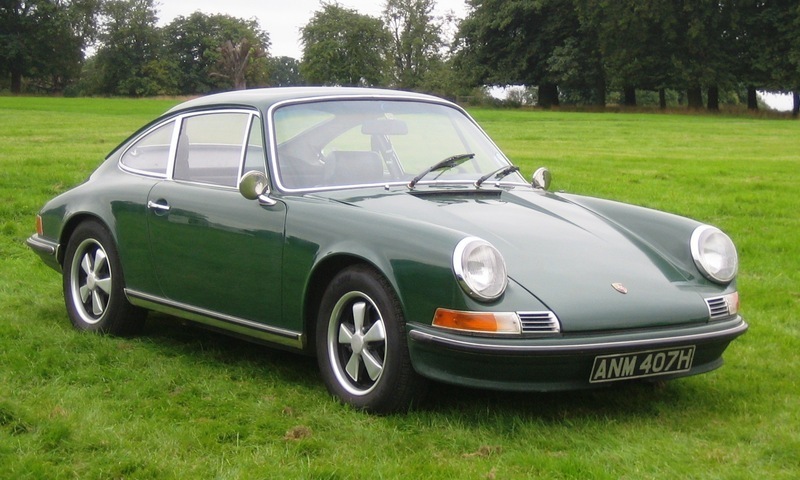
It showed the world German
car manufacturing wasn’t a two horse race between Volkswagen and Mercedes. It
has one of the longest production runs of any car sold in the UK and US
markets. It uses the same air- cooled engine technology developed by Ferdinand Porsche in the
Volkswagen Beetle until 1998.
The Porsche 911 is a 2 door coupé style motor vehicle with a rear located engine supplying power to the rear wheels. Powering the Porsche 911S is a single overhead camshaft, 2 litre naturally aspirated dry-sumped 6 cylinder powerplant, with 2 valves per cylinder that provides power and torque figures of 170 bhp (172 PS/127 kW) at 6800 rpm and 183 N·m (135 lb·ft/18.7 kgm) at 5500 rpm respectively. It features dry sump-type lubrication. A 5 speed manual gearbox supplies the power to the driven wheels. The quoted kerb weight is 1080 kg. It is said to be able to attain a maximum speed of 225 km/h (140 mph).
12) Ford Mustang:
Launched Year - 1964
The first-generation Ford Mustang was manufactured by the Ford Motor Company from April 1964 until 1973. The introduction of the Mustang created a new class of automobile known as the pony car. The Mustang’s styling, with its long hood and short deck, proved wildly popular and inspired a host of imitators. This is the car that
started America’s love affair with muscle and punch. It was the first of its
kind and a wildly popular hit from the start.
The Ford Mustang as the first -- and
so far the only -- car to receive the Tiffany Award for Excellence in American
Design. They all are powered by the 260 cubic-inch V8 engine and equipped with
power steering, back-up lights and an automatic transmission. Other special
features include the blue racing stripe and 'Official Pace Car' decals along
the sides.

13) Jeep Cherokee:
Launched Year - 1974
The SJ series Jeep Cherokee was a full-size SUV
produced from 1974 through 1983 by the Jeep division of the American Motors
Corporation. It was similar to the Wagoneer. Other than the base model, the
trim levels of the Cherokee included the S (Sport), Chief, Golden Eagle,
Limited, Classic, Sport, Pioneer, and Laredo. It was designed by Brooks Stevens.
The Jeep Cherokee was a redesigned
reintroduction of a two door body style, with a single fixed rear side window
with an optional flip-out section. Previously, a two door version had been
available in the Jeep Wagoneer line (1963-67), although this had the same
window configuration as the four door Wagoneer. Based on the Wagoneer, the
Cherokee was marketed as the "sporty" two-door variant of Jeep's
station wagon. When it was equipped with the torquey 6.6liter V8, it would
out-run just about any other 4x4 in its class, and, with 3.07:1 highway
gearing, could reach speeds in excess of 100mph (early models had 120mph
speedometers). A four-door was not added to the lineup until 1977. Engine
choices consisted of AMC I6 or V8 powerplants. The Cherokee was marketed in
left and right hand drive countries (such as the UK and Australia). Main
production of the Cherokee was in Toledo, Ohio.

14) LAMBORGHINI MIURA:
Launched Year - 1966
The Lamborghini Miura is a sports car that was produced by Italian automaker Lamborghini between 1966 and 1973. The car is widely considered to have instigated the trend of high performance, two-seater, mid-engined sports cars. At launch, it was the fastest production road car available.
The Miura was originally conceived by Lamborghini's engineering team, who designed the car in their spare time against the wishes of company founder Ferruccio Lamborghini. He preferred powerful yet sedate grand touring cars, rather than the racecar-derived machines produced by local rival Ferrari.
At its debut the Miura was the fastest production car in the world: With a top speed of 280 kph and an acceleration from 0-100 kph in 6.7 seconds the Lamborghini Miura set new standards in the sports car segment. The original Miura was produced between 1966 and 1969. Between 1966 and 1969 475 units of the 350 HP Miura were produced. But the success story did not end there: The Miura was first developed further into the Miura S with 370 HP and later into the Miura SV, which had wider mud guards and a greatly revamped 385 HP engine with separate lubricating systems for engine and gearbox.

15) Toyota Prius:
Launched Year - 2000
The Toyota Prius is a full hybrid electric mid-size hatchback, formerly a compact sedan developed and manufactured by Toyota. The United States Environmental Protection Agency and California Air Resources Board (CARB) rate the Prius as among the cleanest vehicles sold in the United States based on smog-forming emissions.
The Prius is a passenger car from Toyota, with front wheel drive, a front located engine and a 5 door hatchback body style. The Toyota Prius is one of the NHW11 range of cars from Toyota. The 4 cylinder, double overhead camshaft naturally aspirated powerplant has 4 valves per cylinder and a capacity of 1.5 litres. In this application it musters power and torque figures of 71 bhp (72 PS/53 kW) at 4500 rpm and 115 Nm (85 lbft/11.7 kgm) at 4200 rpm respectively. A continuously variable transmission transfers the power to the driven wheels.
Claimed weight at the kerb is 1250 kg. It is said to be able to attain a maxiumum speed of 160 km/h.


0 comments:
Post a Comment